
How Content is Verified in Guru
Verification is Guru's way of marking content as trustworthy and current. Think of it like a "freshness date" that helps you know which information you can rely on - whether you're searching for an answer, reviewing a Card, or training a Knowledge Agent.
Access Required
- To verify Guru Cards: You must be the verifier assigned to that content, or a member of the verifying Group
- To configure automated verification: Knowledge Agent Owner role (or relevant custom role)
- To verify external sources: Knowledge Agent Owner role (or relevant custom role)
- Viewers Can highlight Card text and add comments to give feedback
New to verification?Learn more about what verification is and why it matters for keeping your knowledge base current and accurate.
Understanding verification in Guru
Verification in Guru is a partnership between people and AI. Your team works hand-in-hand with Knowledge Agents to ensure quality: humans establish accountability and provide strategic oversight, while Knowledge Agents handle the day-to-day work of reviewing content, learning from usage patterns, and flagging issues at scale.
Guru manages two types of content, and each can be marked with a trust signal:
Guru Cards (knowledge you create directly in Guru):
- Default state: Verified with "Does not expire"
- Shows as ✅ Verified, ❔ Unverified, or no badge
External Sources (documents from connected systems like Google Drive, Confluence, SharePoint):
- Default state: None (no verification status)
- Shows as ✅ Verified, ❔ Unverified, or no badge
- Gains verification status once you enable auto-verify for a Knowledge Agent
Once you enable auto-verify for a Knowledge Agent (Guru's AI-powered assistant that searches your knowledge and answers questions), it will start reviewing external sources automatically based on how they're used.
Verification status appears everywhere content is used: in search results, AI-generated answers, the AI Agent Center (the dashboard where you train and improve your Knowledge Agent), and when browsing Cards or sources.
Setting up verification responsibilities
Every Guru Card has a designated verifier - the person or team accountable for keeping that content current. Establishing clear ownership ensures content quality while enabling Knowledge Agents to work effectively on your behalf.
Understanding a Card's trust status
When you open a Guru Card, you'll see its verification status in the top-left corner along with key details:
- Verification/Expiration date – when the Card will become unverified (or "Does not expire" for evergreen content)
- Last verified – who last verified the Card and when
- Verifier – the Group (team) or individual responsible for keeping this Card current
- Verification Interval – how often the Card needs to be re-verified (e.g., every 30 days, 90 days, or "Does not expire" for content that doesn't need regular review)
"Does not expire" is the default verification setting for Cards (for Collections created after January 2026). When set to "Does not expire," the verifier will not receive periodic reminders to review the Card. However, Knowledge Agents will still review this content during their daily runs - if the content fits the verification criteria, the agent will verify or unverify it automatically.
Assigning verifiers
For an individual Card
- Open the Card and click Verified or Unverified at the top left.
- Use the Verifier dropdown to assign an individual or Group.
- Your changes will be saved automatically.
For multiple Cards
Use Card Manager (Guru's bulk editing tool) to update many Cards at once.
- Navigate to the Card Manager in Guru's web app.
- Filter for the Cards you want to update.
- Select Cards via checkboxes. Use the top checkbox to select all.
- Click Change Verifier in the toolbar.
- Click Save changes.
Setting verification intervals
Choose how often content should be reviewed based on how frequently it changes:
For an individual Card
- Open the Card and click Verified or Unverified at the top left.
- Use the Verification Interval dropdown to select:
- Does not expire – for evergreen content that rarely changes
- 30 days, 60 days, 90 days, 6 months, or 1 year – for content that needs regular review
- Your changes will be saved automatically.
For multiple Cards
- Navigate to the Card Manager in Guru's web app.
- Filter for the Cards you want to update.
- Select Cards via checkboxes.
- Click Change Interval in the toolbar.
- Click Save changes.
NoteSetting a verification interval triggers periodic reminders to the assigned verifier. For most content, we recommend using "Does not expire" and letting Knowledge Agents handle ongoing quality checks automatically.
How Knowledge Agents maintain quality
Knowledge Agents don't just find information - they actively maintain its quality. Through automated verification, Knowledge Agents take on the bulk of verification work, continuously identifying outdated content, learning from usage patterns (how people interact with content through thumbs up/down, views, and feedback), and flagging or archiving inaccurate information at scale. Human verifiers maintain oversight and accountability, while agents handle routine quality maintenance.
How automated verification works
Knowledge Agents check for quality once per day, reviewing Guru Cards that are connected to the Agent and external sources that have been used by that specific agent in an answer. When content is reviewed, agents wait 7 days before reviewing it again—this cooldown period prevents unnecessary back-and-forth changes when content is borderline.
The agent applies rules in a specific order: unverification rules run first, then verification rules. This ensures outdated content isn't accidentally marked as verified.
Two types of verification rules
Knowledge Agents use two types of rules to make verification decisions:
| Rule Type | What It Checks | Example |
|---|---|---|
| Behavioral | How people use content (thumbs up/down, views, feedback from experts) | Content thumbs-upped 5+ times in the past month → Verify |
| Content-based | What the content actually says (AI analyzes for dates, time-sensitive info, evergreen topics) | "2025 Benefits" document in 2025 → Verify "How to reset your password" (evergreen) → Verify |
Example: How Automated Verification WorksYour team has a "2023 Benefits Overview" doc in Google Drive. It gets used in 20 AI answers over the past month, but 8 people flag it as incorrect. The Knowledge Agent automatically unverifies it and logs why - alerting your HR team to update it. Once updated, positive feedback causes it to be automatically re-verified. No manual review cycles needed.
NoteContent-based rules can also catch near-duplicate content elsewhere in your workspace. An unverification rule can flag a card as a near-identical copy of another card or source and unverify it, citing the duplicate as the reason. Because the Knowledge Agent evaluates one card at a time, a duplicate rule can only act on the card currently under review, not the duplicate it found.
Setting up automated verification
Auto-verify is enabled by default for all Knowledge Agents built after January 2026.
Enable or review auto-verify settings
To review or adjust settings:
- Go to Manage > Knowledge Agents and select your agent.
- Open the Quality tab.
- Review the Auto-Verify toggle.
- Expand to see the default verification rules.
- Customize rules if needed (optional).
- Select Save.
Enable auto-unverify (optional)
Auto-unverify is off by default to give you control over when content is flagged as outdated. Enable it if you want the agent to automatically flag content that's no longer current.
To enable auto-unverify:
- In the Quality tab, toggle on Auto-Unverify
- Review the default unverification rules
- Customize rules if needed (optional)
- Select Save
Customize verification rules
You can adjust the default rules to match your team's needs. This is optional - the default rules work well for most teams.
- In the Quality tab, expand Auto-Verify or Auto-Unverify.
- Click on any rule to edit it.
- Adjust thresholds (e.g., change "5 thumbs up" to "3 thumbs up").
- Add custom rules based on your workflow.
- Select Save.
Examples of data you can use to build out new verification rules:
| Data Field | Example Use |
|---|---|
| Date of Answer | If the content has been used in an answer in the past 30 days, verify it |
| Status of Answer (Answered, Un-answered, Assigned, Un-assigned, Helpful, Flagged) | If the content has been used in 3 answers marked as helpful in the past 30 days, verify it |
| Group of the user asking the question | If the content has been used in 3 answers marked as helpful by users in the Product Group in the past 30 days, verify it |
| Source information (includes public websites) | If the source is a Gong call… |
| Text of document | If the document mentions football… |
| Last Modified Date | If the document has been modified in the past 30 days… |
| Title | If the title of the document mentions football… |
| URL | If the URL of the document contains getguru.com… |
| Created Date | If the document was created in the past 30 days… |
| Number of Views (over a given period of time) | If the card has been viewed more than 20 times in the past month… |
| Number of Copies (over a given period of time) | If the card has been copied more than 5 times in the past month… |
| Number of Favorites (over a given period of time) | If the card has been favorited more than 15 times in the past month… |
| Number of times card has been followed (over a given period of time) | If the card has been followed more than 100 times in the past month… |
| Number of verification actions (over a given period of time) | If the card has been verified more than 4 times in the past month… |
| Group of user that is performing the action | If the card has been ___by a user in the Product Group more than times in the past month… |
| Content of comments | If a comment on the card has a question mark… |
| Number of comments | If the card has more than 10 open comments… |
| Status of Comment (Open/Resolved) | If the card has an open comment… |
| Comment Created date | If the card has a comment created in the last 30 days… |
| Duplicate content elsewhere in your workspace | If the card is a near-duplicate of another card or source, unverify it |
Configure source limitations
Control which content your Knowledge Agent searches based on verification status. This helps you balance answer coverage with quality control.
- Navigate to Manage > Knowledge Agents and select your agent.
- Open the Quality tab of the Knowledge Agent page.
- Choose your source limitation:
- Verified only: Agent only searches content that's already verified (highest quality, narrowest coverage)
- Verified and no verification status: Agent searches verified content plus content that hasn't been reviewed yet (balanced approach)
- All sources: Agent searches everything connected to that Agent, including unverified content (widest coverage, includes potentially outdated content)
- Select Save
What happens after you enable automated verification?
Once auto-verify/auto-unverify is enabled, here's what to expect:
- Daily reviews: Your Knowledge Agent will review eligible content during its next daily run. Guru Cards will be reviewed daily, and external content must have been used in an answer to be reviewed
- Notifications: The Owners of that Agent receive a digest email or Slack notifications summarizing what was reviewed
- Quality Log updates: Check the Quality Log in the AI Agent Center to see detailed verification decisions with confidence levels and reasons
- No action required: The system works automatically, but you can override any decision if needed
- 7-day cooldown: Once content is reviewed, it won't be reviewed again for 7 days to prevent unnecessary changes
Choosing which sources to verify
By default, quality automations runs against all sources connected to your Knowledge Agent. If you need tighter control - for example, to keep Quality focused on content your team owns - you can scope it to specific sources instead.
- Open the Knowledge Agent and go to the Quality tab.
- At the top of the tab, find the source scope setting.
- Choose one of two options:
- All connected sources (default). Quality runs across every source the Knowledge Agent is connected to.
- Selected sources. A multi-select list appears. Check the sources you want Quality to act on.
- Click Save.
When Selected sources is active, a summary indicator (e.g., "3 of 7 sources selected") appears near the toggles so you can see the active scope at a glance.
NoteNewly added sources are not automatically included in the Quality scope. If you add a source to your Knowledge Agent while using Selected sources, you'll need to manually add it to the Quality scope as well.
Quality also respects any folder filters you've configured for a source. If a source is filtered by folder for Knowledge Agent Answers, the same folder filter applies to Quality — so Quality only touches the content your Knowledge Agent is actually configured to use.
Verifying and unverifying content
While Knowledge Agents handle the bulk of quality maintenance, there are times when human judgment is needed. Whether you're spot-checking critical content, responding to feedback, or addressing content that fell through the cracks, here's how to take direct action.
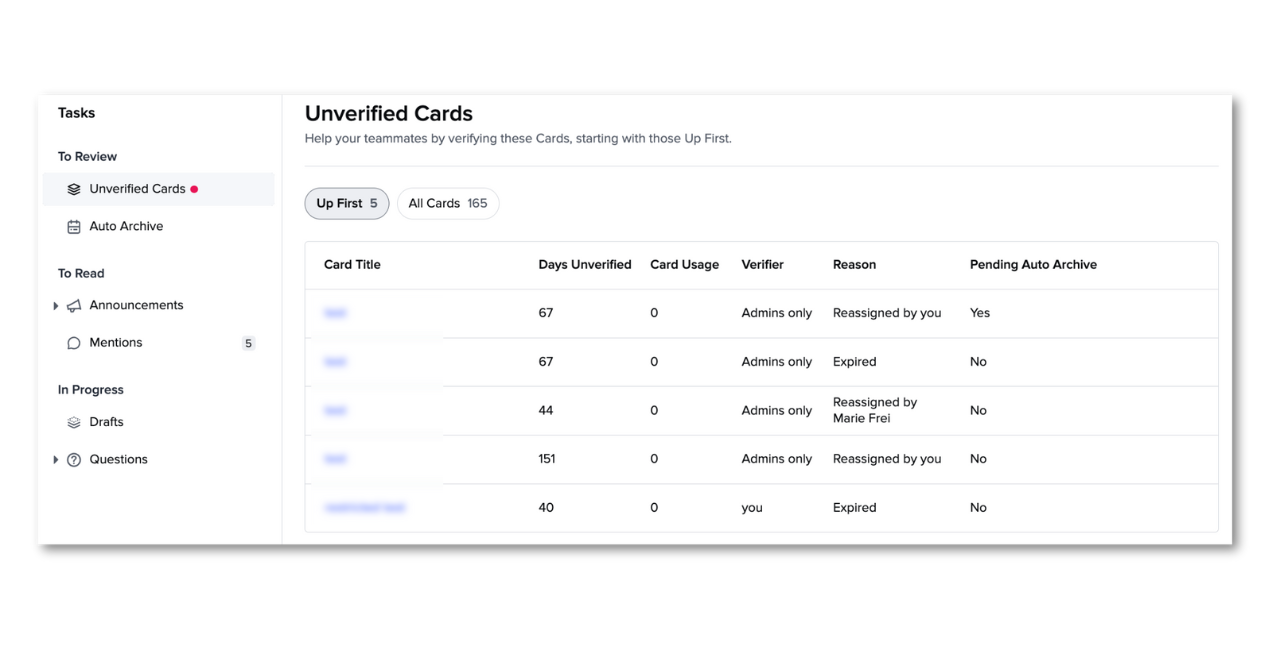
Using the "Unverified Cards" queue
Go to Tasks > Unverified Cards to view Cards needing attention.
- Up First – A curated list of high-priority Cards to review.
- All Cards – Full list of unverified Cards you're responsible for. Sort by column to prioritize your queue.
Click a Card title to view, verify, or edit the Card.
Verifying a Guru Card
Even unverified Cards appear in search results and can be used in answers. Verifiers (people or Groups responsible for keeping specific content current) should review unverified Cards regularly and take one of two actions:
- Click Verify if the Card is up to date.
- Click the Edit icon to make changes, then Publish with the "verify" checkbox selected.
NoteIf someone edits a Card but is not the named verifier (or in the verifying Group), the Card will become unverified and trigger a verification request.
Unverifying a Guru Card
If a Card is inaccurate, others on the team can unverify the Card to request verification.
- Open the Card in the web app or browser extension.
- Click the Verified label in the top left.
- Click Unverify this Card.
All users can also highlight problem text and leave a comment, @mentioning the verifier.
Check a Card's quality status
Want to see if a specific Card should be verified or unverified? Knowledge Agent owners, verifiers, or users with custom verification permissions can run a quality check directly from any Card.
- Open the Card and click the ellipsis menu (•••)
- Select Check Quality
- Choose which Knowledge Agent to evaluate the Card through - each agent applies its own verification rules
- Review the results:
- Status recommendation: Whether the Card should be verified or unverified
- Confidence score: How confident the agent is in this assessment. If you see a low confidence score, that's your signal to get a human in the loop. For example, if the agent says "this should be verified" but shows low confidence, have a domain expert review it before making changes.
- Reasoning: Why the agent made this recommendation
If the recommended status differs from the Card's current status, you'll see an option to verify or unverify it right there.
Monitoring verification activity
NoteA source can only have one verification state at a time. If multiple Knowledge Agents reference the same source, any change to its verification status applies everywhere. When Knowledge Agents "disagree," this actually surfaces sources worth a second look.
The 7 day cooldown period prevents content from being reviewed too frequently.
Understanding why content was verified or unverified is critical for maintaining trust in your knowledge base.
The Quality Log
Every verification decision is logged for transparency and oversight. The Quality Log is located in the AI Agent Center (the dashboard where you train and improve your Knowledge Agent). Learn more about the Quality Log here.
Source Verification Manager
Access Manage > Automations > Source Verification Manager (a tool for managing all your connected external sources) for a comprehensive view of activity taken on external sources. Here you can:
- View verification status across all sources
- Manually verify or unverify sources when needed
- Filter and sort by verification state, last used date, or source type
- Perform bulk actions on up to 50 records at a time
- See who verified content and when
Frequently Asked Questions
Does automated verification replace human verifiers?
No - every Card still has a designated verifier who's accountable for its accuracy. Knowledge Agents take on the bulk of the verification work, handling routine quality checks across hundreds or thousands of sources. Humans maintain oversight: they can review the Quality Log, override any automated decision, and focus their attention on high-stakes content that requires expert judgment.
Can I turn off automated verification for a Knowledge Agent?
Yes. In the Knowledge Agent's Quality tab, you can disable Auto-Verify and/or Auto-Unverify. However, we recommend leaving Auto-Verify enabled - it's designed to reduce manual work while improving knowledge quality.
How often does automated verification run?
Daily. Knowledge Agents review eligible content once per day, applying the verification rules to anything that's been used in an answer.
Will I get notified when content is verified or unverified?
Yes. You'll receive email or Slack notifications summarizing what the Agent reviewed. These notifications are for visibility—no action required, but you can review the details in the Quality Log if you want to investigate further.
How is automated verification different from verification reminders?
Verification intervals trigger periodic reminders to humans who must review each Card individually. Automated verification uses AI and usage patterns to continuously evaluate content quality without human intervention—though humans can always review and override automated decisions through the Quality Log.
Can viewers or non-admins contribute to verification quality?
Yes! All users can:
- Provide feedback on AI answers (thumbs up/down)
- Comment on Cards to flag issues
- Request verification on unverified Cards
This feedback feeds into the behavioral rules that Knowledge Agents use to make verification decisions.
What happens if multiple Knowledge Agents disagree about a source's verification status?
A source can only have one verification state at a time, and that state applies across all Knowledge Agents. When Knowledge Agents "disagree" (one wants to verify, another wants to unverify), this actually surfaces sources worth a second look. Check the Quality Log to understand why each agent made its decision.
Will automated verification unverify my Cards without warning?
Only if you enable Auto-Unverify (it's OFF by default). Even when enabled, the system only unverifies content that meets the criteria set by that agent.
All actions are logged in the Quality Log for review, and you can override any decision.
What happens to content that gets unverified?
It's flagged as unverified but not deleted. It won't appear in search results if your agent is set to "Verified only," but it remains in your system. You can manually verify it again if needed..
I'm seeing the message "No action logs available" on some of my quality runs.
While Owners of Knowledge Agents can see the breakdown of the quality "runs" they can only see the sources that have been processed that they have viewer access to. If you are seeing "no action logs available" this likely means that you don't have viewer access to those sources that were verified/unverified.
Can I revert a quality automation run?
At this time it is not possible to revert a quality automation run. You can always review the sources processed under AI Agent Center > Quality. If you wanted to make any changes to Guru Cards impacted, you can filter for "Last Modified By: [The Agent]"
Can Knowledge Agents detect duplicate content automatically?
Yes. As part of an unverification rule, a Knowledge Agent can flag a card as a near-duplicate of another card or source and unverify it. The check looks at meaning rather than exact wording, so it catches duplicates even when the phrasing differs. It respects your existing permissions: if the duplicate a rule cites is a card you can't access, you won't be able to open it from the Quality Log.
Want a closer look at some key Guru features and best practices?Check out our events page for demos, workshops, new release roundups, Getting Started bootcamp, guest panelists and more! For upcoming live events and a series of past recordings: Click here to register
Updated 25 days ago