
Guru's AI Agent Center
The AI Agent Center is your command center for managing Knowledge Agent performance and quality. It gives you visibility into what your agent is being asked, how it's answering, which sources it's drawing from, and what automated quality decisions are being made—all in one place.
Access RequiredOnly Owners or relevant custom roles can view data regarding their Knowledge Agent in the AI Agent Center. All users can view questions they've asked in the Agent Center.
Monitoring your Knowledge Agent
The AI Agent Center tracks every question asked to your Knowledge Agent and the answer it provided, going back 90 days. Each entry shows the question, the answer, the sources cited, any feedback (thumbs up, flag, or none), and when it was asked and by whom.
Filtering to what matters
The filters at the top of the Questions tab are the fastest way to zero in on areas that need attention. You can filter by Knowledge Agent (if you manage multiple agents), by feedback type (flagged answers are the highest-priority review items), by date range, by asker, or by source used. You can also search for specific keywords to find questions on a particular topic.
A few filtering workflows that surface issues quickly: filter to flagged answers from the past week to catch recent problems, filter by a specific source to see whether a particular document is generating good or bad answers, or filter to "no feedback" to find questions where the answer quality is unknown.
Viewing conversation threads
When users ask questions in chat, those questions are often part of a longer conversation. Any question that belongs to a chat thread will include a View chat thread button, which opens a read-only slideout panel showing the full conversation in chronological order with the selected question highlighted.
To investigate a thread directly in Operator Mode, hover over any row in the Threads table and click Analyze. The thread opens in chat with Operator Mode turned on, and analysis starts right away.
NoteAs an Owner, you won't be able to view a chat thread if it includes an MCP tool call, includes a Research call, or references content you don't have access to.
Providing feedback
Click into any question to see the full answer and source details. From there, you can thumbs up the answer if it was accurate, flag it if it was incorrect or used outdated information, or view the sources used to generate the answer.
This feedback isn't just informational—it feeds directly into the automated verification rules that run daily, helping the system make better quality decisions at scale.
Understanding why an answer was generated
Click Answer Details on any question to see exactly how your Knowledge Agent arrived at its response. The Answer Details panel shows:
- Reason for this answer. A written explanation of how the agent constructed the answer, referencing specific citations and describing how each was used.
- Citations. The sources that were actually cited in the generated answer.
- Sources sent to the LLM. The full list of source documents sent to the model for context, including sources that were considered but ultimately not cited.
- Search terms. The keywords extracted from the user's question that were used to find relevant sources.
- Most relevant sources. The sources deemed most relevant to the extracted keywords, listed in descending priority. This is especially useful when diagnosing unexpected answers. If the right source was sent to the model but wasn't cited, the issue is likely in how the content is written. If the right source doesn't appear in the list at all, the issue is upstream—either the source isn't connected, the search terms didn't match, or the Skill's source configuration needs adjustment.
- Prompt and skill versions. The exact version of the system prompt and/or skill that was active when the answer was generated. Versions are clickable and open the version's full content in a new tab, so a contested answer can be traced back to the precise configuration that produced it — even if the prompt or skill has changed since.
TipTo go straight from a question to Operator Mode analysis, hover over any row in the Questions table and click Analyze. Guru opens the thread that question belongs to with Operator Mode turned on, scrolls to the relevant question, and passes along its Answer ID so the analysis targets the right answer.
Creating a Card from an answer
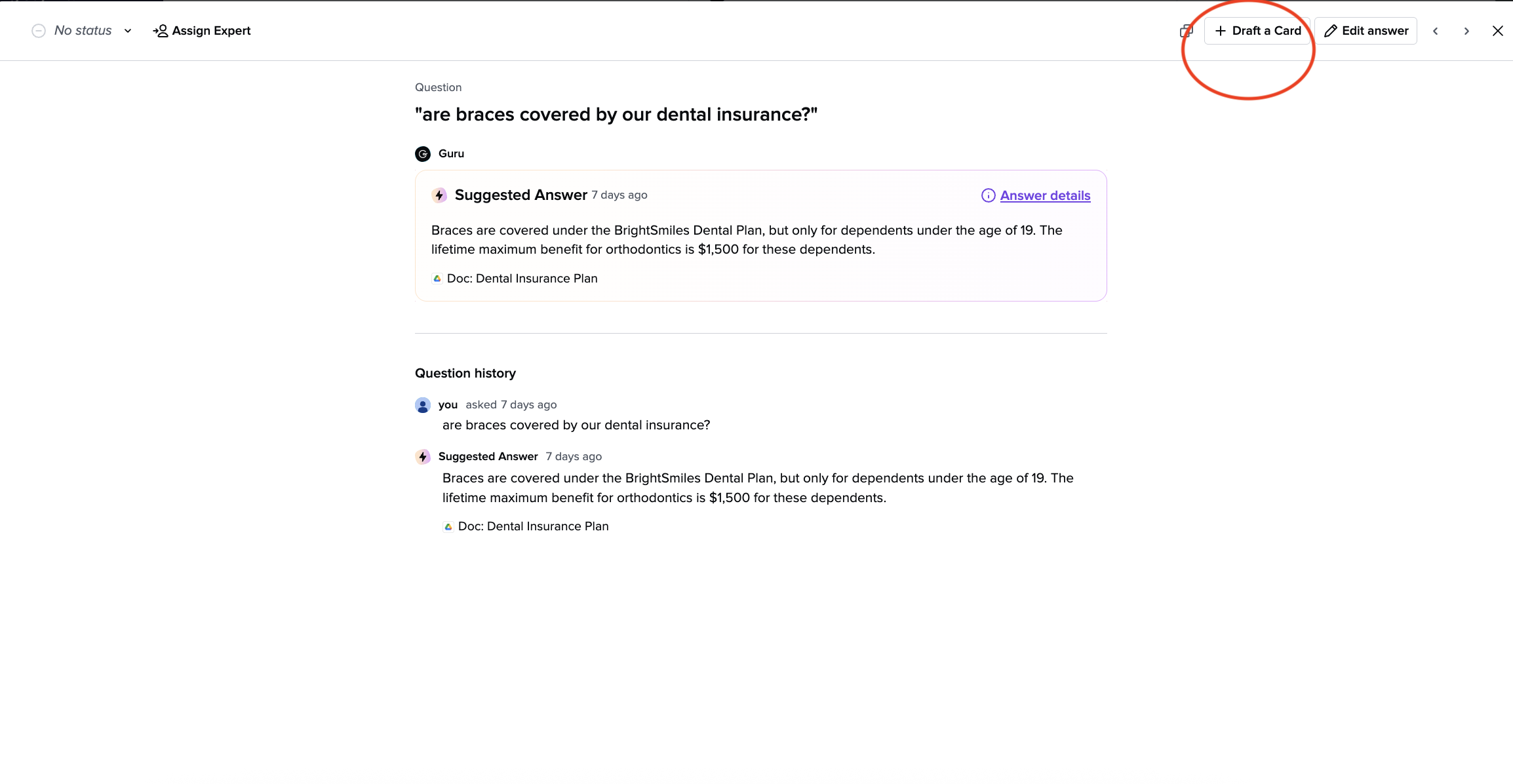
Draft Card from Answer lets you turn a high-quality answer into a draft Guru Card. Only Collection Owners and relevant custom roles have access.
- Open a trusted answer from the AI Agent Center.
- Click Draft a Card.
- The Card Editor opens, pre-filled with the question as the title and the answer as the body.
- Edit and save. The Card is standalone—not tied to a specific Knowledge Agent or Collection.
Controlling what gets tracked in the Agent Center
Each Skill has an AI Agent Center tracking toggle that determines whether its invocations appear in the AI Agent Center at all. When tracking is enabled, each invocation runs post-processing to extract citations, generate an answer explanation, and classify the response as answered or unanswered. When tracking is disabled, the Skill still functions normally, but no AI Agent Center record is created.
NoteMessages sent while Operator Mode is turned on aren't tracked as answers in the AI Agent Center, so configuration work doesn't show up alongside your agent's question and answer data.
This matters because the monitoring, filtering, and querying workflows described in this article only apply to Skills with tracking turned on. If you're not seeing a Skill's activity in the Agent Center, check whether its tracking toggle is enabled.
The default Answer Skill has tracking enabled by default. The default Research Skill has tracking disabled by default. You can enable or disable tracking on any Skill at any time under Settings > Skills on your Knowledge Agent.
Improving answer quality
Knowledge Agents with Skills operate differently from legacy Knowledge Agents. Skills give agents specialized behavior for specific workflows, with configurable instructions and routing — which makes them easier to improve, because the levers are clearer: the content the skill draws from, and the skill's own configuration.
ImportantThis section applies to Knowledge Agents with Skills enabled. For legacy agents without Skills, see Legacy Knowledge Agents (without Skills).
Knowledge Agents with Skills
The improvement loop for skills-based agents runs through three levers: the source content, the skill configuration, and the connection between them. The Agent Center is where you identify what needs fixing. Operator Mode is where you fix it.
Diagnosing a bad answer
When you spot a flagged or unexpected answer, click Answer Details to see exactly how the agent constructed it — which skills fired, which sources were pulled, and where the response went wrong. This tells you which lever to pull:
- The right source wasn't found. Content may be missing, outdated, or not connected to the agent. This is an opportunity to improve the content.
- The right source was found but not used. The skill's description may be too broad, or its instructions may be routing the answer incorrectly. Alternatively, there are higher ranking sources.
- The source and routing look right but the answer is still off. The skill's custom instructions may need refinement.
Fixing it with Operator Mode
For skills-based agents, Operator Mode is the primary way to act on what you find in the Agent Center. Click Analyze on any row in the Questions or Threads table to open the chat with Operator Mode already on. You can also turn on the Operator Mode toggle in any chat and give it the answer ID or thread ID you're investigating. Then ask why the answer went wrong.
Once you know what went wrong, you can also correct the answer itself. Work out the right answer with the agent, then say "update the answer." Guru saves the new text and sources and emails the person who asked. Learn more about updating an answer.
TipYou can also use Operator Mode proactively — not just for bad answers. Use it to build new skills, refine instructions across multiple skills at once, or test how the agent handles a specific question before it reaches users.
Keeping content quality high
Operator Mode handles skill configuration. Source content quality is managed separately.
- Turn on quality automations. Automated verification and automated card management ensure outdated or redundant content is flagged or removed before it affects answers. Auto-verify is enabled by default; auto-unverify can be enabled under the Quality tab.
- Query the Agent Center for patterns. Use chat or research mode in the Agent Center to surface trends across your agent's activity — sources frequently cited in flagged answers, topics that consistently go unanswered, or questions returning incomplete information. See Querying the AI Agent Center for trends for example prompts.
Legacy Knowledge Agents (without Skills)
For agents that don't use Skills, you can edit individual answers and assign questions to experts directly from the AI Agent Center.
Editing a suggested answer
Edit an answer by clicking into a question, selecting Edit answer, choosing the sources the answer should draw from, reviewing the regenerated response, and saving. The original asker is notified of the updated answer.
- Click the question row to expand the details.
- Click Answer Details, then Edit answer.
- Under Step 1, select sources for the answer. You can search connected external sources (excluding Slack), search and apply existing Guru Cards, edit a source Card, remove a source, or create a new Guru Card (+ New Card).
- Under Step 2, review the regenerated answer and select 🔄 refresh if needed.
- Click Save answer to finalize.
NoteOn Knowledge Agents with Skills, update answers with Operator Mode instead. Assigning questions to experts isn't available for Knowledge Agents with Skills.
NoteIf you've added web search functionality to a Knowledge Agent, you cannot use web pages to train the AI. Guru performs a specific search at the moment the question is asked.
Assigning a question to an expert
To route a flagged or incomplete answer for expert review:
- Click the question row to expand the details.
- Click Assign Expert.
- Choose an individual or Group to respond. Guru may suggest experts.
- (Optional) Add a note for context.
- Click Submit. The expert will be notified via their preferred notification settings. (Experts assigned via Slack will see it in My Tasks but won't receive a separate notification.)
Reviewing unverified sources
When your Knowledge Agent filters sources by verification status ("Verified only" or "Verified and no verification status"), you may see a collapsed section titled "Unverified Sources that may be relevant to this question." This surfaces sources that were relevant but excluded because they haven't been verified yet.
Expanding this section lets you review the unverified sources, open them to read full content, edit content directly (if you have verification permissions), or add a source to the answer—which automatically verifies it and triggers answer regeneration.
NoteThis section only appears when your Knowledge Agent uses verification-based source filtering and relevant unverified sources exist. Users without verification permissions can view sources but cannot add them to answers.
Understanding your sources
The Sources tab shows which content from your connected sources is being used to answer questions—and how trusted that content is.
Each source displays a verification status: a green checkmark for verified content, a gray indicator for unverified content, or no badge for content that hasn't been reviewed yet (the default state). Depending on your Knowledge Agent's configuration, it may only use verified sources, or it may use both verified sources and sources with no verification status.
You can filter by verification status, source type, usage frequency, or Knowledge Agent.
The Sources tab is most useful for identifying high-value content (sort by usage to find your most-cited documents), finding unverified content that's being relied on heavily, and understanding coverage gaps between what's connected and what's actually being used.
Automated quality maintenance
The Quality tab gives you transparency into automated verification decisions. This is where your feedback from the Questions tab and the usage patterns from the Sources tab come together into automated maintenance.
How automated verification works
Automated verification runs daily, reviewing Cards and source documents that have been used in answers. Based on behavioral, content-based, and analytical rules, your Knowledge Agent automatically verifies or unverifies content. Learn more about automated verification.
Auto-verify is enabled by default for all Knowledge Agents. Auto-unverify is disabled by default—enable it when you're confident in your rules.
The Quality Log
The Quality Log is a running record of every verification event. Each entry shows which document was verified or unverified, when it happened, the reasoning behind the decision, and a confidence level:
- High confidence. Strong signals supported the decision (e.g., content thumbs-upped 10+ times with no flags).
- Medium confidence. Moderate signals (e.g., content viewed regularly but limited feedback).
- Low confidence. Limited or ambiguous signals (e.g., content used only once or twice). Worth reviewing manually.
Review the Quality Log weekly to spot unexpected changes, investigate why a source was unverified, or assess whether your verification rules need tuning. If you're seeing many low-confidence decisions, your rules may benefit from more specificity.
Querying the AI Agent Center for trends
Instead of manually reviewing individual questions and answers, you can use chat or research mode to conversationally query your AIAC data and surface patterns across your agent's activity.
Chat mode returns the first 50 results per request for fast, focused insights. Research mode supports deeper exploration across multiple pages of results. Both support filtering by Knowledge Agent, asker, time period, status, and source used.
Prompts to try
- "What are the top trending questions for this agent over the last 30 days?"
- "Show me all flagged questions from the past week."
- "Which questions went unanswered in the last 30 days?"
- "What topics are getting the most thumbs-down feedback?"
- "Which sources are being cited most frequently in answers that receive negative feedback?"
Regular querying helps you identify content gaps, catch Skill routing issues early, and prioritize which sources or Skills to refine next.
Pairing trends with quality automations
The insights you surface through AIAC querying become more powerful when combined with Guru's quality automations. Turning on automated verification and automated card management (auto-archive and duplicate detection) means the patterns you identify—outdated sources, content that's consistently flagged, duplicate documents competing for citations—can be addressed automatically over time rather than requiring manual cleanup. Use AIAC trends to spot the problem, then configure your automations to prevent it from recurring.
TipFor agents with Skills enabled, Operator Mode lets you act on what you find here without leaving the agent. Give it a thread ID or answer ID and ask why the answer went wrong — it walks through the trace and can update the skill in the same session.
Validating answer quality with AI Evals
ImportantAI Evals doesn't train your Knowledge Agent. It's a way to set your own answer quality benchmarks, so Guru can continuously check that we're improving the product on our end without disrupting the answers you rely on.
While the AI Agent Center helps you monitor and improve individual answers, AI Evals lets you lock in your own answer quality benchmarks and have Guru continuously test against them. AI Evals has its own page in the left navigation, alongside the AI Agent Center.
Pick the question and answer pairs that matter most to your team, mark them as evals, and Guru automatically re-runs those questions every day to confirm the agent is still answering them the way you expect. If a model change, prompt update, or other system change ever affects how one of your evals is answered, Guru is notified internally and works to resolve it before it reaches your team.
Creating an eval
Evals are created from real Q&A history - you can't create one from a hypothetical question. Not every answer is eligible; only answers with Agents (with Skills enabled) that you are an owner of.
- Find an answer from a Knowledge Agent that you want to use as a benchmark in the Agent Center.
- If the answer is eligible, you'll see an Add as eval option.
- Select Add as eval.
When you mark an answer as an eval, Guru saves a snapshot of everything needed to replay it later - the question, the expected answer and explanation, the cited sources, all documents considered, and the underlying LLM conversation.
The AI Evals page
From the AI Evals page, you can:
- See every eval you have permission to view, scoped to the Knowledge Agents you manage.
- Filter the list by Knowledge Agent.
- See the date and time of the last successful run for each eval.
- Delete evals individually or in bulk.
- Export the list to CSV for compliance reporting or audits.
How evals run
Evals run automatically once a day. There's no manual trigger and no real-time enforcement. For each eval, Guru re-runs the saved question against the current system and compares the new result to the snapshot, checking:
- Answer consistency: Is the new answer semantically consistent with the expected answer? (Meaning, not exact phrasing.)
- Source alignment: Did Guru use the same or equivalent sources to generate the answer?
Frequently asked questions about the Agent Center
What's the difference between Answers analytics and the AI Agent Center? Answers Analytics (available to Admins, Knowledge Agent Owners, and relevant custom roles) shows feature adoption and usage by Group, all questions answered or not answered, and CSV export. The AI Agent Center (accessible to Experts and Knowledge Agent Owners) shows the full question, answer, sources, feedback, and actions taken. It has a 90-day history, is not exportable, and is used to review and improve AI responses directly.
Will research appear in the AI Agent Center? No. Research results can be found by the individual who conducted the research in the Chat window in the left-hand column.
What does it mean when I see a lock icon and "Answer Hidden"? This means you don't have access to the source within Guru, or the source has been deleted since the question was asked. If you have access in Guru but not in the external source (or aren't logged into it), clicking the source link will result in access being denied.
How often does automated verification run? Daily. No content is reviewed more than once within a 7-day window.
Why don't I see all verification events in the Quality Log? The Quality Log respects source permissions. If you don't have access to a document, you won't see its verification events.
What content is eligible for automated verification? Only content that has been used in an answer. This ensures verification focuses on content that actually matters.
How do I improve answers for a Knowledge Agent with Skills? Review the content your Skills reference and the Skills' own configuration. Start with the source content (is it accurate and complete?), then check the Skill's description and instructions (is it routing correctly and responding appropriately?). Learn more about configuring Skills. For additional guidance, contact [email protected].
Why can't I find a chat thread I'm looking for?
A thread won't appear if it includes an MCP tool call, includes a Research call, or references content you don't have access to. It's also possible the asker deleted their own thread, which removes it from the AI Agent Center entirely. There's currently no way for Admins to prevent users from deleting their own chat threads.
Want a closer look at some key Guru features and best practices?Check out our events page for demos, workshops, new release roundups, Getting Started bootcamp, guest panelists and more! For upcoming live events and a series of past recordings: Click here to register
Updated about 9 hours ago